Sunday, 23 January 2011

The sleepover

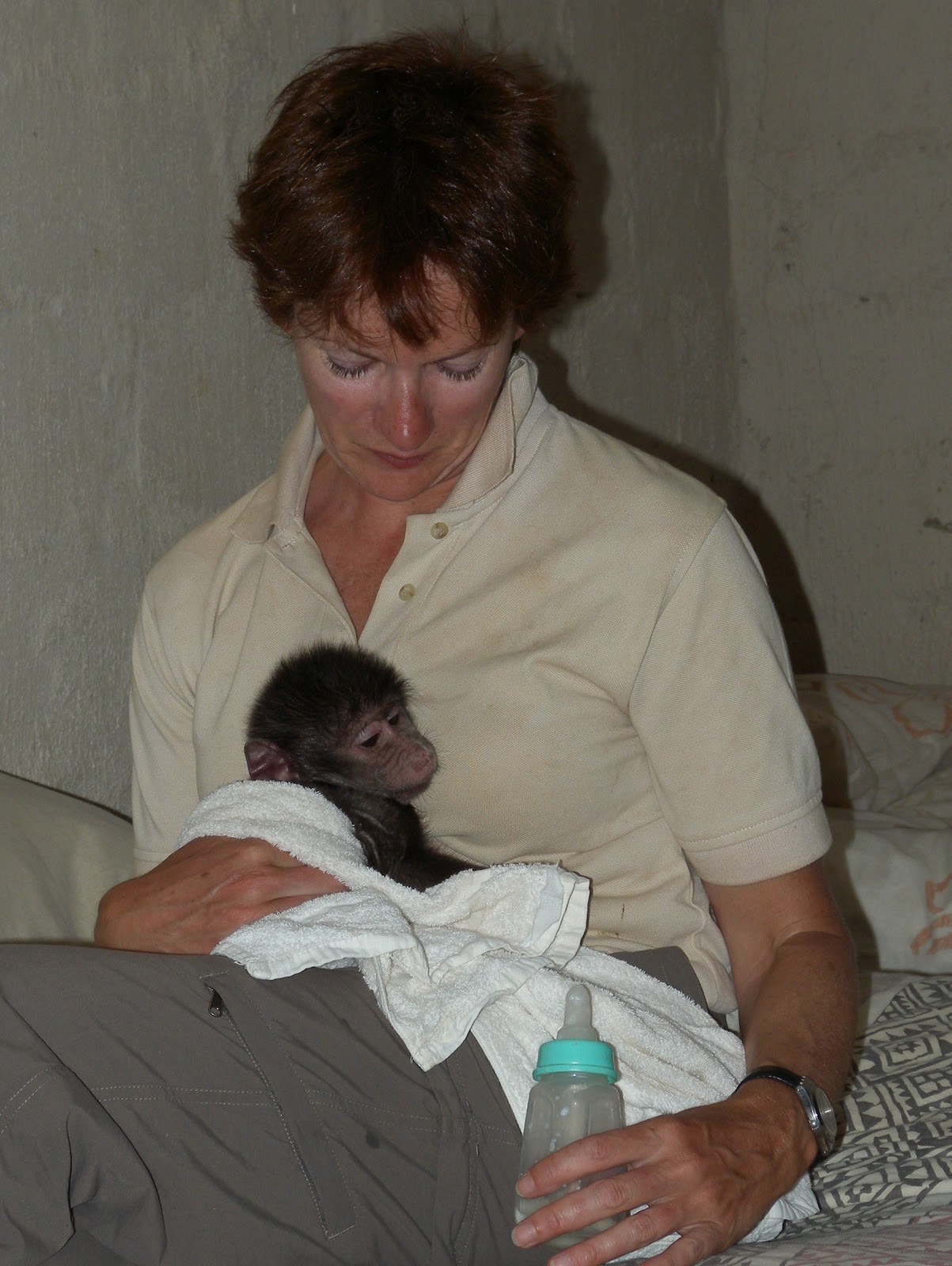
There are two baby baboons at the sanctuary - Rudi who is around 3 months old and Rafiki who is about 8 months old. In the wild, they would normally sleep cuddled up against their mother for warmth so all the volunteers were offered the opportunity to be a surrogate for a night.

My roommate and I were scheduled to take them on my third full day at the sanctuary and I was a little apprehensive as I hadn't had much time to bond with them. The night before, two other volunteers had their turn to take the baby baboons for the night and it descended into chaos because they'd had no briefing on how to handle them and no time for the baboons to get to know them beforehand. And a stressed baboon tends to scream the house down, and then piss and crap all over you. It's a special experience..

Like any baby, they need to be washed before they go to bed so we had to give them a bath. We filled up a large plastic container with warm water and then - just as you would for a human baby - tested the temperature by dipping an elbow in. We bathed Rafiki first, who is not terribly keen on the whole process and tends to express his discomfort by crapping in the water that you're trying to wash him with.

Rudi, on the other hand, appears to like the water and I was told that the easiest way to wash him is to take a shower with him. So a key milestone was passed in my life that day: taking my first shower with a baboon. I'm afraid I don't have any photos to mark the occasion as it was already tricky enough trying to take my clothes off and then shower with a baby baboon clinging on to me. Rudi seemed to be familiar with the whole procedure and once under the shower, looked like he was in seventh heaven with his little eyes closed - just like he was under hot rain. I'd forgotten to take the dog shampoo in with me, so we had to make do with Organics shampoo for normal hair. But it did at least promise extra shine.

Once we'd finished, I managed to wrap him in his towel and then dry and dress myself one-handedly while I held him against me. I have to say, it was quite a moving experience and I think we shared a moment.

Back in the room, it was then time for another first in my life: putting a nappy on. I like to think that I jumped straight in at the deep end on this task compared to how it would have been with a human baby. For starters, you have to cut a hole in the back of the nappy to thread the tail through. And with a baboon, you have the added challenge that it is capable of leaping all round the room as you attempt to get the nappy on - unlike a human baby who is at least constrained to just lying on its back and kicking its legs.

Nappy on, it was then time for a feed. After all the excitement, Rudi just about managed to stay awake until he'd finished the bottle and then we settled down to go to sleep. He led by my side throughout the night, suckling on the empty bottle from time to time. I didn't have the deepest sleep I've ever had, but I was relieved to wake up and find that I hadn't rolled over and squashed him in the middle of the night.

In the morning, it was a repeat of the process from the evening before. Rudi and I took another shower, but this time he insisted on sitting on my head. This actually proved to be quite efficient - particularly when I went to the toilet beforehand, as I could at least operate in hands-free mode.

I helped my roommate give Rafiki a bath and true to form, he crapped in the water again. I naively hoped that the mere act of dunking him in the water would be enough to clean his messy bottom, but no. My roommate confirmed my worst fear - that I would just have to "get in there". Cleaning a baboon's pooey bottom with my bare hands was not on the list of things I'd hoped to experience during this trip, but as the old saying goes in life - "shit happens".

Trying to hang on to Rudi!


Too cute!

Making some nappy adjustments!

Baboon Earth Mother

Wide awake again..

Then fast asleep

Well chilled

A hog for the dogs

The sanctuary is also home to 14 wild dogs that came there together as a litter of pups. Wild dogs are an endangered species, with an estimated population of less than 5,000 worldwide. Increasing urbanization has reduced the amount of territory available to them and they have also been widely hunted. They live in large packs and operate in a highly co-operative way, particularly when it comes to hunting.

Wild dogs have a fearsome reputation, largely because they start to eat their prey while it is still alive, typically by disembowling it - unlike the big cats who first kill their prey by breaking its neck or biting its throat to suffocate it.

The wild dogs at the sanctuary were given a special treat that week in the form of a whole warthog to devour. The dead animal was loaded onto the pick-up truck and a number of volunteers, including myself, had to squeeze in alongside it as we drove to the wild dog enclosure.

The dogs seemed to anticipate the feast that was awaiting them, as they were all together only metres from the gate. We then lifted the warthog off the pick-up truck and carried it in the enclosure, while some of the staff kept the pack at bay with sticks. Once they were allowed to attack, they collectively tugged on the carcass to rip its flesh, causing its legs to wave around as if it were still alive. It didn't take long to reduce a full-size carcass to just skin and bones.


Friday, 21 January 2011

Carnivore feeding

In addition to the vegetarians, there are a number of big, hungry carnivores that need to be fed each day. The sanctuary generally sources horse and donkey meat for this purpose, which arrives in large, recognisable body parts that need to be cut smaller by some lethal-looking electric saw device. As volunteers, we are not allowed to use this in case we chop one of our arms off.


The cut meat is then loaded up into a crate and taken on the rounds to the lions, cheetahs, leopards and caracals. The meat-eaters are fed every day except Sunday, when they are left to fast. In the wild, they would have different eating patterns. Lions generally kill every 2-3 days, while cheetahs need to kill every day.

Most of the cats have come into the sanctuary because they were becoming a nuisance on farm land. In the past, farmers would simply have shot them to save their livestock, but the Namibian government has taken innovative measures to encourage conservation. If a farmer reports that a cheetah or leopard has killed some of their stock, they will receive compensation - but only if they don't kill the predator. The government then takes steps to organise the capture and relocation of the animal. Naankuse has been on the receiving end of some of these relocations and, where possible, will try to reintroduce the animals back into the wild - in new locations where they're not likely to become a nuisance to livestock again.

Our first stop on the carnivore feeding was the cheetahs. Whilst they're not supposedly a threat to humans, they didn't look too friendly when we arrived with their food. They hunch down and have this haunted look on their face, hissing and spitting at us with hungry impatience. Once the meat was thrown over the fence, they ran off with it for fear of losing it to someone else. Cheetahs are the fastest animals on land - capable of running up to 75mph and going from 0-60mph in just 3 seconds. But they can only maintain high speeds for short distances - for as long as it takes to chase and capture their prey - and they're are not strong enough to fend off other predators who might opportunistically muscle in on their kill. So they are used to losing their kills on many occasions, hence the motivation to disappear with the meat as soon as they've got it - even in captivity.


The leopard, on the other hand, is pretty nonchalant after getting his food. He has no need to run anywhere and can take his time to savour it.


Then it's on to the lions. In the wild, it's usually the lionness that does all the work. She hunts, chases and kills the prey, while the male struts around looking tough and making sure he doesn't mess his mane up. In the sanctuary, one of the males is called Meatball and he does actually look like he puts straighteners on his mane and have it regularly trimmed. We have to throw the piece of meat to him first to make sure he's preoccupied and doesn't take the meat intended for the lionness, who is disproportionately larger than him, a bit of a bruiser and looks like she could take him on any day. In a pride in the wild, the male seems to have god-like status and all his energies (such that they are) appear to be focused on procreation and continuing the blood line. Yeah..

Looking good, Meatball

Hey, don't mess my mane up

Okay, I'll stand behind you and you do the roaring

I caught it all by myself!


Thursday, 20 January 2011

First encounters of the baboon kind

There are a lot of baboons at the Naankuse Wildlife Sanctuary. Most of them have come in as babies, orphaned when their mothers were shot. They are divided into three separate enclosures: babies (up to 12 months old); senior babies (1-2 years old); and adults. After one week at Naankuse, we did reflect that this might also have been a useful way of separating the volunteers too.

Each day the baby baboons and the senior babies are taken out for a walk - to encourage them to forage naturally, allow them to explore new territory and basically let rip. The different groups of volunteers took it in turns to take them out, first making sure that they had "baboon-proofed" themselves by removing all hats, sunglasses, cameras etc and were wearing long trousers. But even your choice of clothing can cause problems. We were told of a previous volunteer who wore loose tracksuit bottoms with a stretchy waist. The baboons apparently pulled them down and pulled off her top, so she was forced to walk back in just her underwear.

On my second full day at the sanctuary, I just happened to be passing near the baboon enclosures when another group of volunteers were returning from their walk. The babies and senior babies were still running loose before being put back inside. As I was wearing all the things that they would want to get their hands on - hat, sunglasses, camera, necklace - I naively thought I could hide behind a bush and not draw attention to myself. I thought I had succeeded until one baboon wandered further away from the pack, spied me and came running over. Within seconds, he was pulling on the back of my sock as I tried to walk along while clutching tightly onto my hat, camera and sunglasses. Thwarted in his attempt to get his hands on my booty (as in belongings), he called all his mates over.

I'm not sure how many baboons were climbing up me or clinging on as I endeavoured to keep moving, but I was mightily relieved when a member of staff came running towards me to beat them off. It was during this episode that I learned how hard baboons can bite. I actually watched one of the little bastards pinch a piece of skin on the back of my calf - yes, I was wearing shorts too - and then proceed to sink his teeth into it. And he looked me right in the eye as he did so. Any fledging aspirations I might have had to become The Baboon Whisperer disappeared then and there. And I am still sporting the scars from those bites today.

When they promised me a "hands-on" experience with animals, I had assumed it would be me getting my hands on the animals. Not the other way round.

Do I look like I take 'no' for an answer?

Don't  be deceived by the whole 'cute' routine


WHAAA!

One-two-three-four-five.  One-two-three-four-five.

Okay, group hug!

Foodprep

A key responsibility of the volunteers each day is to prepare food for all the animals - or "foodprep" as it is otherwise known. There is a designated area for this in one of the farm buildings, which has a big whiteboard on the wall with all the details of who eats what:
  • Baby baboons - bottled milk which seems to be the same mixture as you would give to a human baby. They also have chopped fruit mixed up with mealie pap - a maize-based substance that is popular throughout Africa and similar in texture to polenta or grits.
  • Adult baboons - chopped fruit mixed up with mealie pap.
  • Meetkats - pieces of raw chicken, which must be hand-fed to them.
  • Goats - bottled milk.
  • Pigs - mealie pap mixed with chopped fruit and any other leftovers from the kitchen.
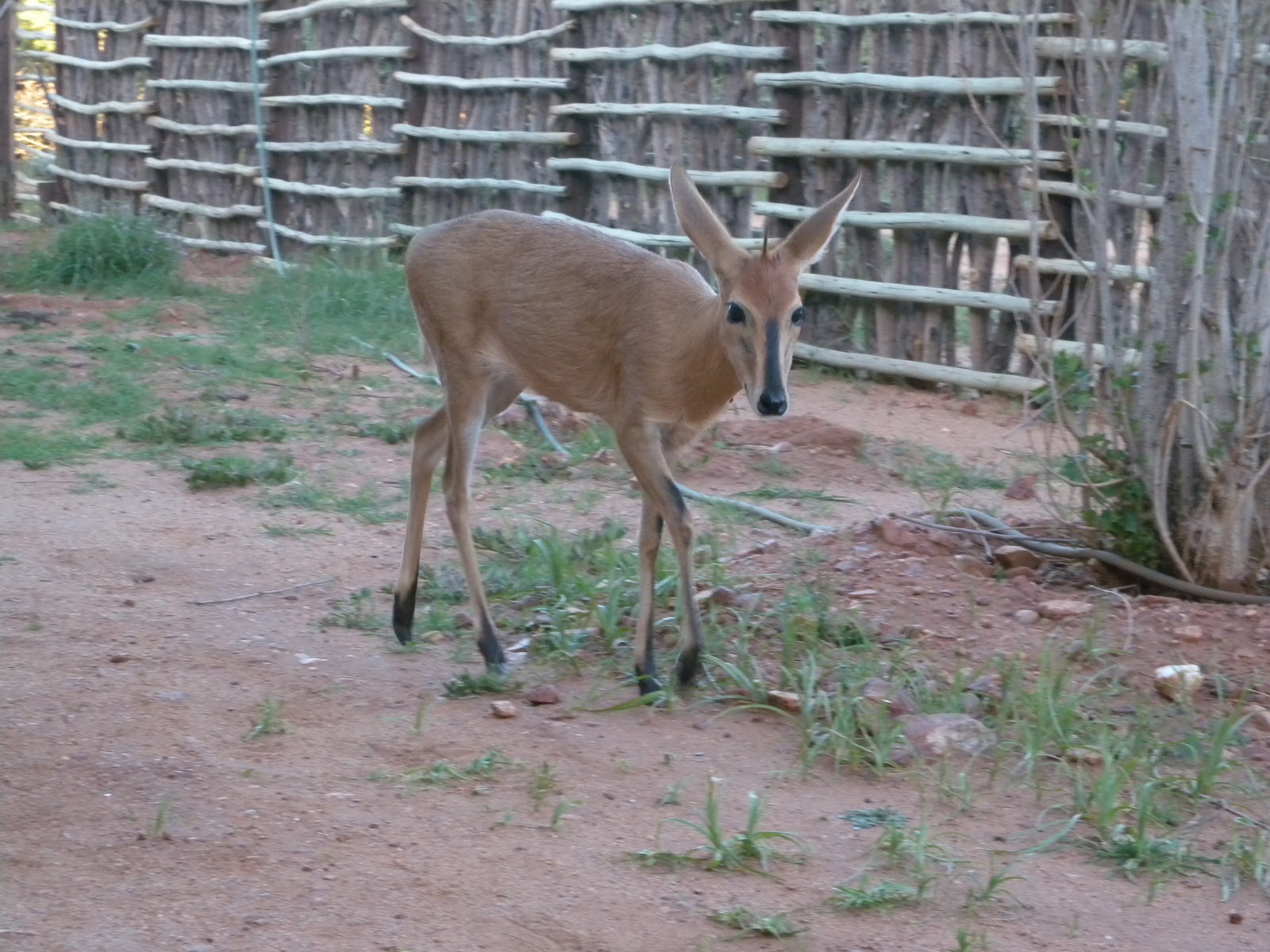
  • Sylvie the Duiker - chopped apples and carrot.
  • Rabbits - chopped apples and carrot.
  • And so forth...
It sounds simple enough, but it takes at least an hour at the start of each day to do foodprep for whichever group is assigned this task. There is a considerable amount of fruit to be chopped - fruit that is starting to go off and wouldn't be sold for human consumption such as blackening, mushy bananas; rotting apples, papaya and mango.

And each animal seems to have its own fussy individual requirements that need to be catered to. Sylvie the Duiker has a small mouth apparently, so the apples and carrots need to be chopped a bit smaller for her. My suspicion is that if Sylvie the Duiker is that hungry, she'll find a way of getting it down.


Sylvie the Duiker who has a very small mouth

On my first day of doing foodprep, the mealie pap mixture was a lot sloppier than it normally would be. In essence, it looked, felt and smelt like cold vomit. And you have to get into it pretty much up to your elbows in order to mix it up with the vast quantities of chopped fruit. The normal procedure for the adult baboons is to make it into ball shapes which can then be thrown over the fence into their enclosure.

But on this occasion, we had to resort to scooping up handfuls of the stuff out of the bucket and then trying to fling it over the fence. The sloppiness of the mixture meant that there was a certain amount of splash-back as it flew through the air. And even the baboons looked non-plussed as it splatted on the ground in front of them.

I must admit, I did reflect on the wisdom of my decision to jack in my high-flying career as I spent the rest of the day picking bits of mealie pap off me, which had dried to a nice hard crust once the hot sun baked it on.

I can get more in, I know I can..
Any room for me in there, Marlin?

Hey guys, leave some for the rest of us

Wednesday, 19 January 2011

Scary brief

The briefing on my first day at Naankuse was very informative on all the things I should be scared about.

Snakes: Cape cobras, black mambas and zebra cobras are the deadliest ones in the area. If we get bitten by any of these, we've basically got two hours. They don't keep any antidotes at the sanctuary, but the staff assure us that if they put their foot to the floor, they can reach the hospital in Windhoek within half an hour. But if you get bitten in a main artery, then things don't look good.

Scorpions: these are as dangerous as getting stung by a bee apparently.

Cheetahs: they don't generally attack humans, but we are advised not to turn our backs on them or crouch down as they get confident and will see us as prey.

Leopards: apparently you can never trust them as they become wild again as they get older. I can relate to that. Indeed, the owner of the sanctuary looked after some leopard cubs from when they were just a few weeks old and took them out every day for five years. Then she had to go away for two weeks and when she returned, noticed from their eye contact that they had changed towards her. She knew that she would never be able to take them out again.

Baboons: apparently you should never say "no" to them. If you don't give them something, they will call the rest of the troop to come and jump on you. We were advised therefore to take nothing with us when we're taking the baboons for a walk - no sunglasses, cameras, hats, watches or jewellery - because they will trash it. And we should also wear long trousers not shorts, because they climb all over you. And we should empty our pockets before we go. Because if we don't, the baboons will.

After the briefing, my first task was to go into one of the cheetah's enclosures and give her a brush - from a tall standing position, obviously. She seemed to enjoy it, purring loudly just like a house cat. Despite their reputation for being relatively timid, it is a little disconcerting to be that close to the fastest mammal on land. On another occasion, the same cheetah licked my arm. I wasn't sure if she was simply being affectionate or preparing to sink her teeth into me.

Later that afternoon, we took two of the leopards out for a walk. They first had to be coaxed into a smaller cage whilst still in their enclosure. Then the cages were lifted onto a pick-up truck and transported to an open area where the leopards could be released and allowed to stretch their legs a little more. That said, they didn't go far. The considerable heat - even in the late afternoon - didn't motivate them to exert themselves too much. But when it's cooler or raining, we're assured they're a lot friskier and it can be difficult to find them again.


Welcome back!

I have returned home to the UK safe and sound after my 8-week adventure, although it feels much longer after everything I've managed to pack in.

I arrived at the Naankuse Wildlife Sanctuary in Namibia on 20 December. "Naankuse" in the local bushman language means "God is watching over us". I wish he had been, because surely he wouldn't have put me through this if he was..

Most of the wildlife that I encountered at Naankuse was of the 18-25 year old human kind, which is predominantly a nocturnal animal and seeks regular sustenance on alcohol. In essence, Naankuse - as I experienced it - was like Club 18-30 does ecotourism.

After being one of only three volunteers at the Amakhala Game Reserve in South Africa, it was a shock to find there were 27 volunteers at Naankuse. The whole set up was something of a hot-house environment, with very basic dorm-style accommodation and only one seating area where you ate and socialised. Although the sanctuary was only about 35 minutes drive from Windhoek, it was in a remote location with no easy way to get out. Taxi fares to go anywhere were quite expensive and so even by the end of my first day, I was already beginning to think I would go nuts if I stayed there for four weeks.


My room

The accommodation block

On top of the high number of volunteers, the situation was not helped by a reduced number of staff. Some had gone home for the holidays; some had friends and family visiting and weren't so focused on the job; and there were also some celebrity guests at Naankuse which distracted the attention of the staff - more on that later.

All in all, the feeling was that volunteers were pretty much left to get on with it ourselves. We were split into three groups and one volunteer was appointed as the group leader. Despite their enthusiasm, the group leaders were put in a rather difficult position as they didn't always know what they were doing and even if they did, they didn't necessarily have the people skills to manage such a diverse group of people of different ages, cultures and motivations for being there.