Saturday, 12 February 2011

Luderitz and Kolmanskop

From our base in Aus, we took a day trip to Luderitz on the coast and the deserted mining town of Kolmanskop. We were well into the Namib desert here and driving down the jet black tarmac road that cut through the yellow sand made us feel like we were in the middle of a some sort of computer game.

Luderitz is a throw-back to German colonial times with its art nouveau architecture, bakeries and cafés. Poor transport links have kept it off the main tourist track, but it's worth swinging by if you're down in the south. The town was founded shortly after the discovery of diamonds in the Sperrgebiet area in 1908. It quickly became a boomtown as hordes of prospectors descended upon it and facilities sprang up to support the burgeoning diamond mining industry. Before things got out of control, the German government declared the south-west area of Namibia the "Forbidden Zone" and independent prospecting became illegal.

On the road to Luderitz

Architecture around Luderitz


From Luderitz, we came back to Kolmanskop which is probably one of the most surreal places I have ever visited. It's an old mining town that sprang up after the initial discovery of diamonds in the area, but when richer diamond fields were found around the mouth of the Orange River in 1928, the industry gradually migrated to Oranjemund and Kolmanskop became deserted. The last inhabitants left in 1956 and the desert sands have been gradually invading the town ever since. The ghost town was opened up as a tourist attraction about 20 years ago and it's possible to walk inside all the houses and see the sand piling up in the rooms. It's creatively inspiring enough to bring out the arty photographer in everyone.

The town was home to around 1,000 people in its heyday, including elegant German ladies in their long crinoline dresses. On the day we visited, there was a strong wind blowing and fine particles of sand flying everywhere. I cannot imagine living there in the middle of the desert on a permanent basis. It must have been boring as hell and so to provide distraction, the town had its own bowling alley, casino and even a theatre.

The story of the diamond discoveries in Southern Namibia is quite fascinating. It is said that a railway worker found a shiny stone alongside the railway track near Grasplatz and gave it to his employer, August Stauch. It was confirmed to be a diamond and the rest is history.. It is said that there were so many diamonds in the area that people were crawling through the desert on their hands and knees, picking diamonds up out of the sand. And this continued for the first 18 months or so after the initial discovery.

Today, the diamond industry is controlled by the Namdeb Diamond Corporation Ltd, which is jointly-owned by the Namibian government and the De Beers Group. As we toured through the reception area, we learned that the De Beers world-famous slogan - "A diamond is forever" - was voted the top advertising slogan of the century by the prestigious US magazine Advertising Age, in a special edition published in January 1990. The long-running advertising campaign successfully established the purchase of a diamond to denote engagement. As the world's hardest natural material, De Beers could certainly feel confident in standing behind their advertising claim that the diamond would indeed last "forever", if not the matrimonial bliss that it sought to commemorate.


Friday, 11 February 2011

Black mamba attack

Okay, I admit the title of this post may be slightly exaggerated in order to get people to read it, but it was pretty close..

The one animal that I had not seen on my trip to this point was a snake. I had heard stories of other people seeing them, but I had never actually laid eyes on one myself. Not that I was hoping to - far from it. And as phobias go, I think it's a fairly healthy one to have.
The location of the near "attack" was the campsite at Aus, our next destination after the Fish River Canyon. The campsite was reminiscent of the Wild West in terms of the tumble-weed type grasses all around and the style of the accommodation. The campsite was within a 10,000-hectare ranch which had a number of hiking trails running through it. On our first night we took the Sunset trail, which was a short route that supposedly gave a great view of the sun setting. We left for our walk a little too early and ended up sitting on a rock for 20 minutes or so waiting for the sun to go down. We also missed the track to the viewing point and so didn't actually see too much of the sunset, but the warm golden light cast on the rocks all around made up for it all the same.


Our campsite

A wild dog in her tent


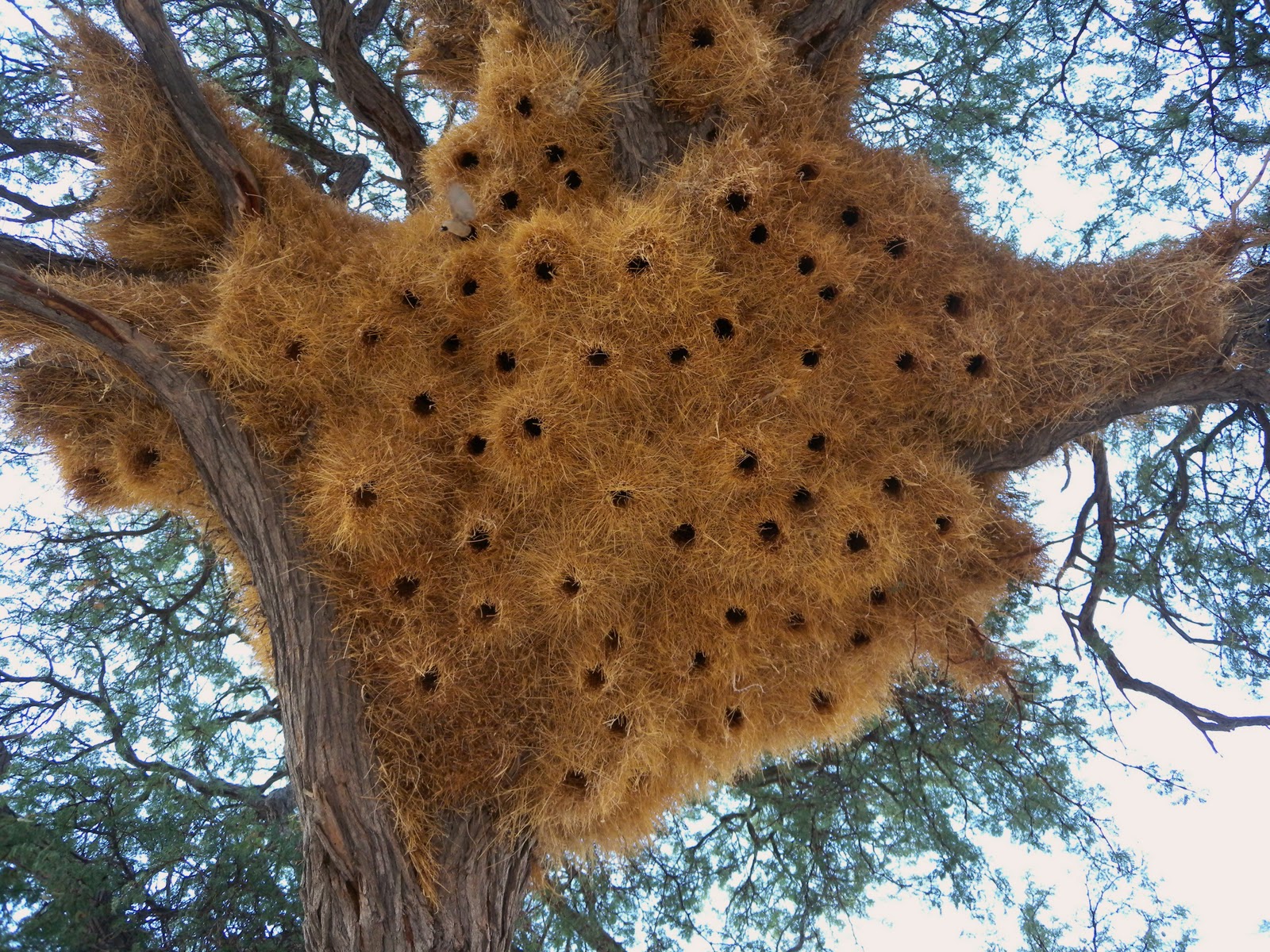
As we returned to the campsite, we passed a tree with a huge nest in it that looked just like a hay-stack. It was the handiwork of the Sociable Weaver, a small bird that likes to build a large communal nest that can house over 100 pairs of birds. These are the largest nests built by any bird and consist of an elaborate series of chambers. The view from the bottom of the nest is quite incredible, revealing the beautiful structure that the messy side view does not.

The Sociable Weavers' nest


The nest from the bottom

It was on our second night at the camp that we took another stroll around and returned to the same tree. I was about to walk straight under the nest and look up into it, when one of my fellow campers noticed there was a snake hanging out of the nest and called out just in time to stop me in my tracks. The snake had gone up there in search of eggs to eat. After retreating to a safe distance, we stood there for a while watching it. It took what we interpreted as an aggressive posture, raising its head to face us and attack if we approached any closer. We don't entirely know what type of snake it was, but on the basis that it was black and ready to attack, I put my money on it being a black mamba.

I had visions of me being seconds away from re-enacting the scene from Kill Bill Volume 2, where Daryl Hannah's character hands the case of money over to the cowboy in the caravan. He is in the middle of taking the money out, when the black mamba hidden underneath the pile of bank notes, rises up and bites him right in the face.

Since returning home, I have poured over photos of snakes on the internet to try and identify my would-be attacker and came down to a shortlist of a spitting cobra or a cape cobra. as its head appears to be slightly wider in the second photo below. But if there are any snake experts out there and can tell me what it is, I would be interested to know..


Black mamba??

Monday, 7 February 2011

The Forbidden Zone

We awoke to the noise of what we thought was our camp chef getting the breakfast things out. But it turned out to be a baboon who had tipped the dustbin over and was picking through the contents for food. My tent-mate was just getting up when she saw it scampering away.

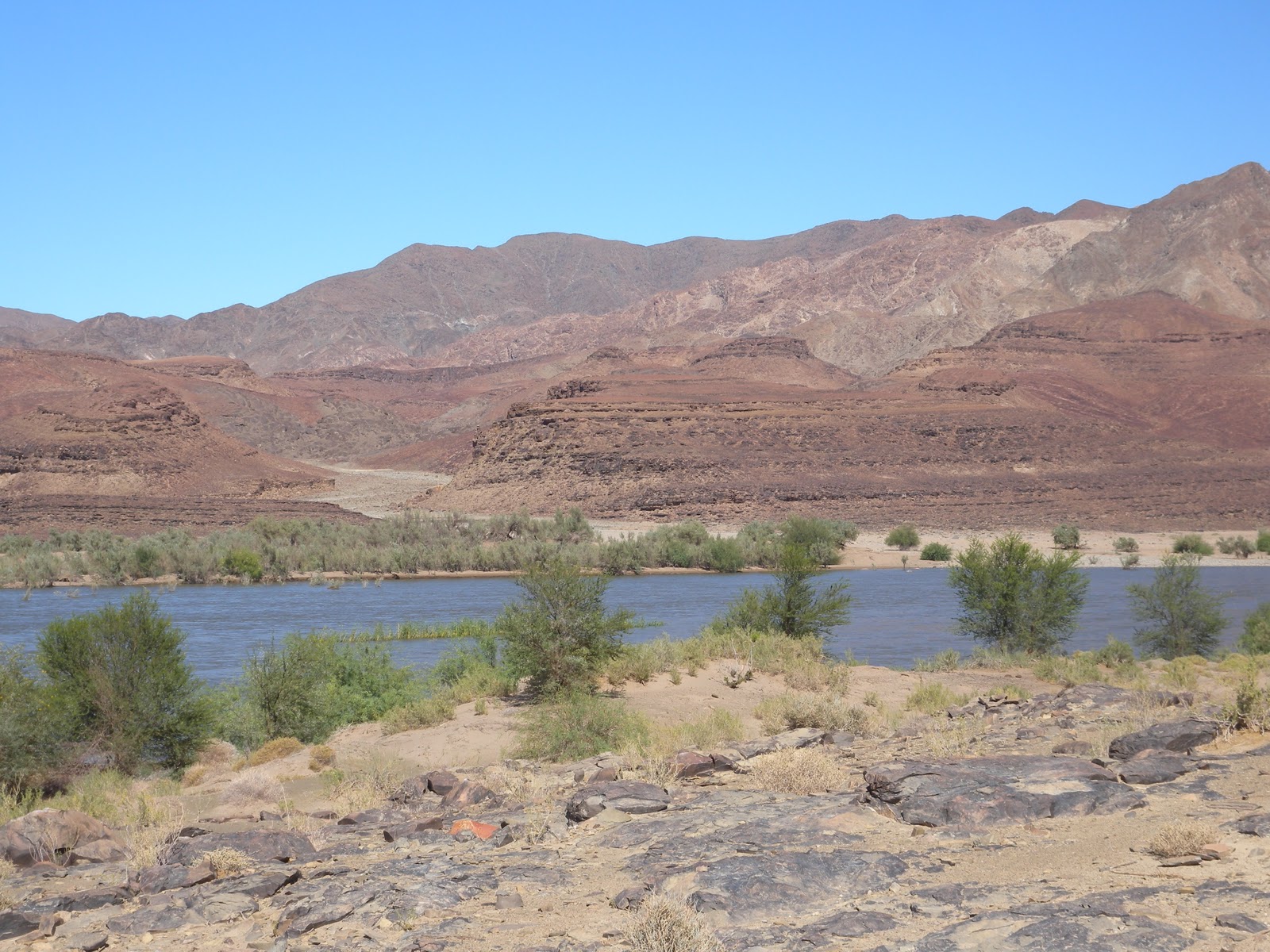
From the Fish River Canyon we continued further south until we reached the Orange River, which forms the border between Namibia and South Africa. In such a barren landscape, the river looks remarkably vibrant. The name is derived not from the orange-coloured landscape which surrounds it or the colour of the water, but rather the Dutch monarch Prince William V of Orange.

Vines are grown on the banks of the river on the Namibian side. The grapes are then sold to South African wine producers who turn it into a very palatable red wine. We sampled a bottle of it that evening with the sense of contentment and connectedness that always comes from drinking a local vintage.

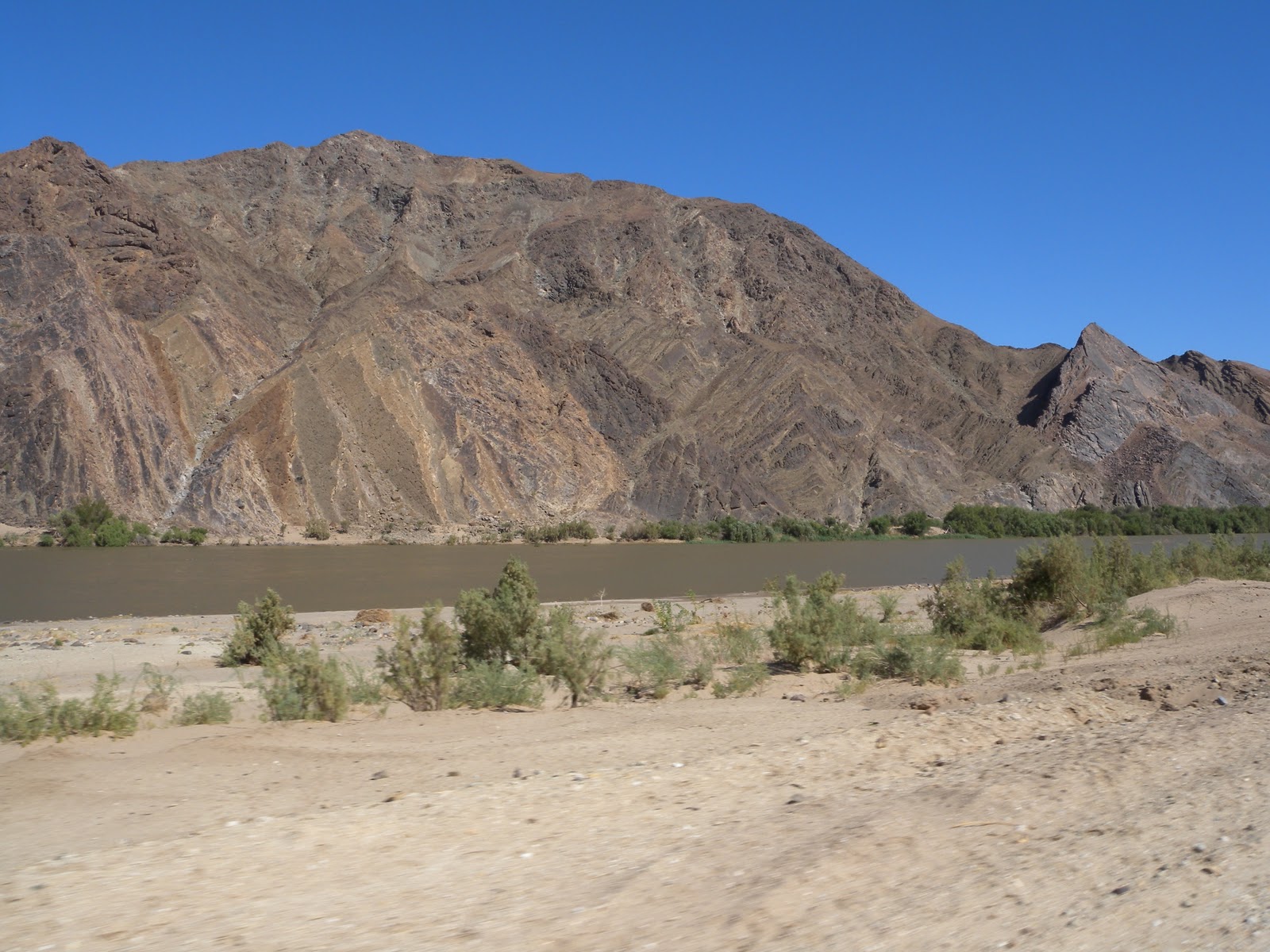
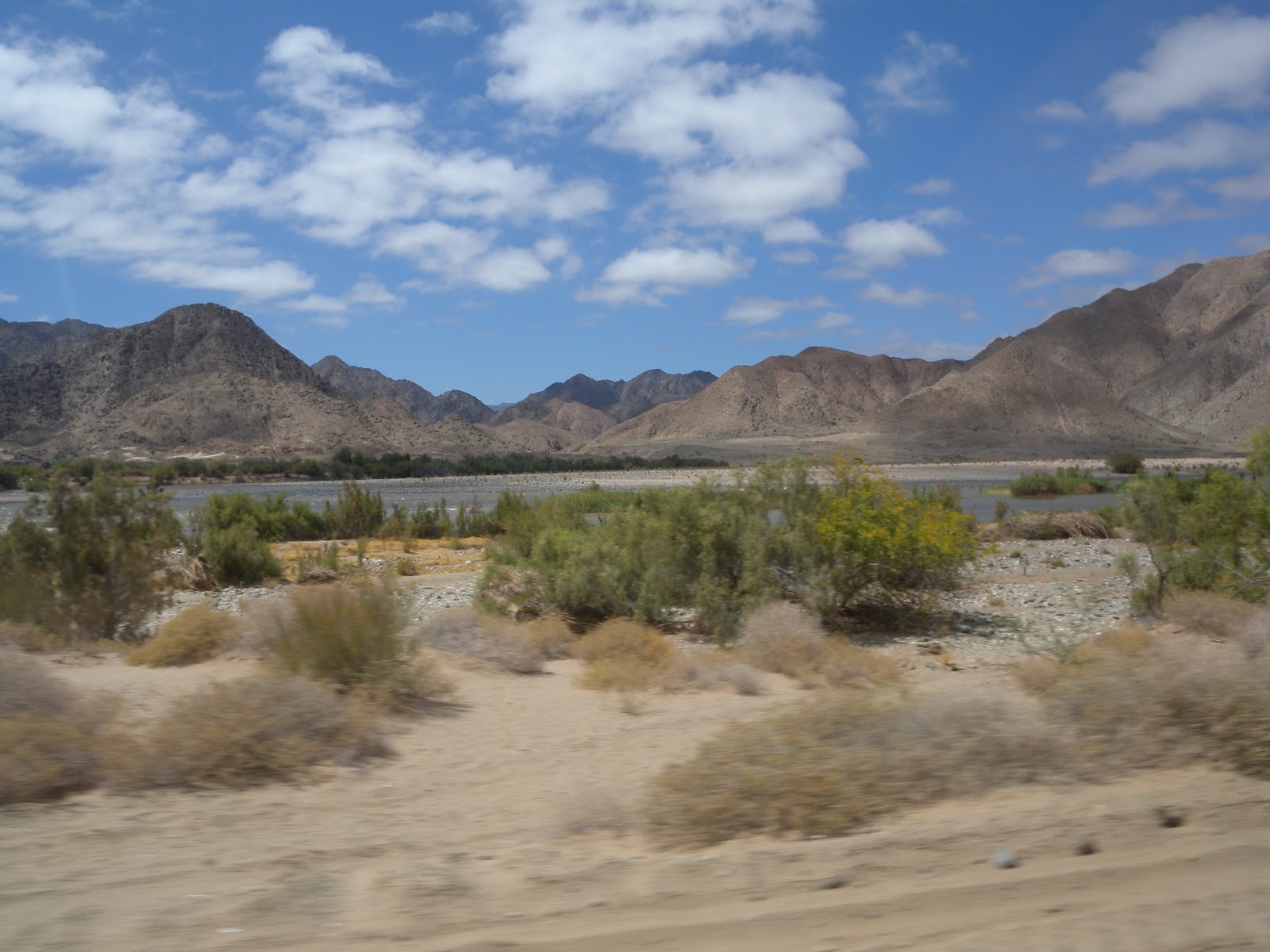
We continued alongside the Orange River until it joins the Fish River which comes down from the canyon. From here, we started heading North again which took us along the Fish River and into the so-called "Forbidden Zone". We were now in diamond mining territory. The zone was formed in 1908 when diamonds were discovered in the area. In 2008, the area was designated as the Sperrgebiet National Park and because it has been off-limits for so long, it is pristine and an area of unique biodiversity. It is impossible to drive through the park with a private vehicle and all the tour companies have to apply for special permits to enter.

At the northern boundary of the park, we had to stop at what looked just like a border control. A uniformed guard inspected our vehicle in case we'd stashed some diamonds in there as we drove through. Then after reviewing our passports as well - even though it was not an international border - we were allowed to continue. We stopped for lunch by the side of road in another 'middle of nowhere' location. When they say that the south of Namibia is all about scenery, they're absolutely right. And it doesn't disappoint.


The Orange River


Where the Fish River joins the Orange River

Driving alongside the Fish River


Leaving the Forbidden Zone


A quiet spot for lunch